

Dilma Rousseff: Brazilian congress votes to impeach president
Government concedes after lower house overwhelmingly backs move to remove Rousseff, who now faces vote in senate
- Rousseff impeachment: what happens next?
- Brazilian president Dilma Rousseff suffered a crushing defeat on Sunday as a hostile and corruption-tainted congress voted to impeach her.
In a rowdy session of the lower house presided over by the
president’s nemesis, house speaker Eduardo Cunha, voting ended late on
Sunday evening with 367 of the 513 deputies backing impeachment –
comfortably beyond the two-thirds majority of 342 needed to advance the
case to the upper house.
As the outcome became clear, Jose Guimarães, the leader of the
Workers party in the lower house, conceded defeat with more than 80
votes still to be counted. “The fight is now in the courts, the street
and the senate,” he said.
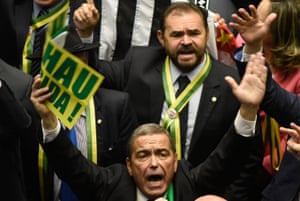
As the crucial 342nd vote was cast for impeachment, the chamber
erupted into cheers and Eu sou Brasileiro, the football chant that has
become the anthem of the anti-government protest. Opposition cries of
“coup, coup,coup” were drowned out. In the midst of the raucous scenes
the most impassive figure in the chamber was the architect of the
political demolition, Cunha.
Watched by tens of millions at home and in the streets, the vote –
which was announced deputy by deputy – saw the conservative opposition
comfortably secure its motion to remove the elected head of state less
than halfway through her mandate. There were seven abstentions and two
absences, and 137 deputies voted against the move.
Once the senate agrees to consider the motion, which is likely within
weeks, Rousseff will have to step aside for 180 days and the Workers
party government, which has ruled Brazil since 2002, will be at least temporarily replaced by a centre-right administration led by vice-president Michel Temer.
On a dark night, arguably the lowest point was when Jair Bolsonaro,
the far-right deputy from Rio de Janeiro, dedicated his yes vote to Carlos Brilhante Ustra,
the colonel who headed the Doi-Codi torture unit during the
dictatorship era. Rousseff, a former guerrilla, was among those
tortured. Bolsonaro’s move prompted left-wing deputy Jean Wyllys to spit
towards him.
Eduardo Bolsonaro, his son and also a deputy, used his time at the
microphone to honour the general responsible for the military coup in
1964.
Deputies were called one by one to the microphone by the instigator
of the impeachment process, Cunha – an evangelical conservative who is
himself accused of perjury and corruption – and one by one they
condemned the president.
Yes, voted Paulo Maluf, who is on Interpol’s red list for conspiracy.
Yes, voted Nilton Capixiba, who is accused of money laundering. “For
the love of God, yes!” declared Silas Camara, who is under investigation
for forging documents and misappropriating public funds.
And yes, voted the vast majority of the more than 150 deputies who
are implicated in crimes but protected by their status as
parliamentarians.
At times the session exposed the farcical side of Brazil’s democracy,
such as the Women’s party that has only male deputies, or the
Progressive Socialist party that is one of the most right-wing groups in
congress.
Brazil’s
presidential chief of staff Jaques Wagner said the government was
confident the senate would dismiss the impeachment, insisting the vote
was a setback for democracy and was “orchestrated” by Rousseff’s
opponents who never accepted her re-election victory in 2014.
But Rousseff’s chances of survival look slim. Brazil has turned
dramatically against the country’s first female president. Once one of
the most popular leaders in the world, with approval ratings of 92%,
Rousseff has since seen her support plunge as a result of economic
recession, political turmoil and the Lava Jato investigation into corruption at Petrobras, which has implicated almost all of the major parties.
Several senior Workers party officials have been arrested in
connection with the scandal and former president Luiz Inácio Lula da
Silva is under investigation.
As a former energy minister and head of her party, critics say Rousseff
should have known what was going on, but she has not been charged.
Recent polls suggest only 10% of the public think the president is doing a good job and 60% support her removal.
But many are uneasy about the dubious grounds for impeachment.
Rousseff is accused of window-dressing government accounts with a
temporary transfer of money from state banks ahead of the last election.
Supporters says this minor and common infraction is being used as a
pretext for a “coup” to seize power by a political class that is
notorious for far more serious crimes. About a third of the lower house
deputies are either under investigation or charged with crimes.
On Sunday night, Brazilian television channels showed streets full of
pro-impeachment protesters dancing in celebration. Many draped
themselves in the national flag and at one point they burst into a
chorus of the national anthem. With each declaration from congress, the
crowds cheered and booed as if in a pantomime or a football match. One
even released a confetti cannon, briefly filling the air above him in a
glittering cloud of colour.
On the streets, the crowds that had rallied to show support for or
against impeachment were more civil than their elected representatives.
Hundreds of thousands took to the streets across more than a dozen
cities, the vast majority of them opposed to the government. Outside the
congress building in Brasilia, the two sides were divided by a steel
barrier.
The anti-government side was jubilant at the prospect of change.
“Dilma has robbed the people with corruption and inflation. We must get
rid of her,” said Raquel Rosas, a school teacher who sat on a Brazilian
flag waiting for the result with her 17-month old daughter and other
families members. “But getting rid of her should only be the start.
Temer and Cunha must go too.”
On the other side of the fence, the crowd was smaller and more muted.
Some bore banners saying “Defend Democracy” and “Respect My Vote”, in
reference to tens of millions of ballots cast for Rousseff in the last
election that impeachment threatens to negate.
 Pro-government demonstrators watch the vote count on a screen. Photograph: Felipe Dana/AP
Fabio Moura, a lawyer from São Paulo, said he was disgusted by the
opposition because many of them have been implicated in the Lava Jato
investigation into corruption at Petrobras. “They are just trying to
impeach Dilma so they can stop the investigation,” he said.
“It is not bad for us to lose today. It means the opposition will
have to make unpopular spending cuts and that will help us in the next
election,” he said. “But this looks like being a bad day for democracy.”
Dilma Rousseff: Brazilian congress votes to impeach president
![Dilma Rousseff: Brazilian congress votes to impeach president]() Reviewed by Admin
on
05:15:00
Rating:
Reviewed by Admin
on
05:15:00
Rating:


No comments: