

BE CAREFUL AROUND HOSPITAL ENVIRONMENT
Solaade Ayo-Aderele
The way some patients and visitors carry
on when they are in the hospital environment leaves much to be desired.
Take, for instance, a nursing mother who allows her baby to crawl
around, fully aware of the possibility of the child picking things and
putting them in his mouth.
Where there is no object in sight, the child may insert his dirty hands in his mouth for whatever reasons.
What about adults who touch all
available surfaces as they use the hospital, without the faintest idea
that they may pick up infectious pathogens that could make them and
everybody in their circle – family and friends – sick.
Experts note that hospitals are
notorious for spreading lethal infections, and hospital-acquired
infections (medically called nosocomial infections) now affect one in 25
patients.
Indeed, researchers note that the most
common hospital-acquired infections include central line-associated
bloodstream infections (which occur when germs enter the bloodstream
through a central line); catheter-associated urinary tract infections,
surgical site infections after surgery and clostridium difficile
infections (a bacterium that causes diarrhoea and more serious
intestinal conditions).
Paediatrician and President of the Anu
Dosekun Healthcare Foundation, Dr. Efunbo Dosekun, warns that the
situation is growing more dangerous because it has been found that
hospital-acquired infections may not respond to regular antibiotics.
Dosekun laments that people who have
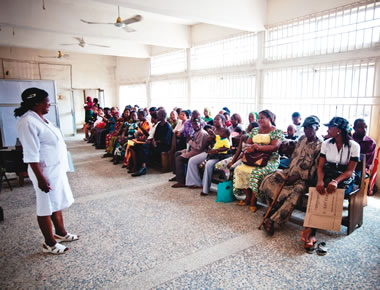
contagious infections are allowed to mingle freely with other patients
as they all wait to see the doctor. Consequently, she says, someone who
has come to treat malaria fever may return home with tuberculosis if he
happens to come into contact with the droplets of an infected person in
the hospital waiting room.
The World Health Organisation warns that
infections are caused by pathogens that easily spread through the body.
Many hospital patients have compromised immune systems, so they are
less able to fight off infections. In some cases, patients develop
infections due to poor conditions at a hospital or a healthcare
facility, or due to hospital staff not following proper procedures.
Some patients acquire nosocomial
infections by interacting with other patients, Dosekun says; while
others encounter bacteria, fungi, parasites, or viruses in their
hospital environment.
She adds that the ‘social status’ of a
hospital may also determine the level of infections that patients and
health workers alike would be exposed to. In other words, Dosekun says,
the higher the net worth of individuals a hospital caters to, the rarer
it becomes for patients to be infected.
“This tells you something about the
association of poverty with diseases. Poverty, ill health and ignorance
are closely interlinked and each is a determinant of the other. Those
with poor health tend to fall into poverty and the poor tend to have
poor health. And that’s why persons with lower socio-economic status
also have the worst health outcomes.
“Again, environmental and social
reasons, including crowded living and working conditions, inadequate
sanitation, and disproportionate occupation all contribute to developing
weakened immunity, which readily exposes the vulnerable such as babies,
pregnant mothers and aged persons to higher risks of infection,”
Dosekun notes.
The way out
Dosekun says first of all, infection
control is the responsibility of all health care professionals. As such,
they must practice the following.
Hand decontamination
She says that transmission of hospital
infections can be minimised with appropriate hand hygiene; while care
givers must be knowledgeable about possible risks and procedures so as
to guard against infections.
Personal hygiene
“All hospital staff must maintain good
personal hygiene. Nails must be clean and kept short. False nails should
not be worn. Hair must be worn short or pinned up. Beard and moustaches
must be kept trimmed and clean,” experts counsel.
Shoes
Dosekun says in all aseptic units and operating rooms, health workers must wear dedicated shoes, which must be easy to clean.
Safe injection practices
In order to prevent transmission of
infections between patients who take injections, experts suggest the
elimination of unnecessary injections, and the use of disposable sterile
needle and syringes. “After they are done, they must also follow safe
sharp disposal practices,” the physician says.
Preventing environmental transmission
“To minimise the transmission of
microorganisms from equipment and the environment, adequate methods for
cleaning, disinfecting and sterilising must be in place. Written
policies and procedures which are updated on a regular basis must be
developed for each facility,” Dosekun advises.
Cleaning of the hospital environment
Experts say routine cleaning is necessary to ensure that a hospital environment is visibly clean and free from dust and soil.
“This is because 90 per cent of
microorganisms are present within visible dirt, and the purpose of
routine cleaning is to eliminate this dirt. There must be policies
specifying the frequency of cleaning and cleaning agents used for walls,
floors, windows, beds, curtains, screens, fixtures, furniture, baths
and toilets, and all reused medical devices” Dosekun adds.
Gloves
Hospital workers are expected to wear
sterile gloves for surgery, and also when attending to patients. Gloves
must be changed each time a new patient is to be examined. Hands must be
washed when gloves are removed or changed; while disposable gloves
should not be reused.
As for hospital visitors and patients, always wash hands with soap and water after visit.
BE CAREFUL AROUND HOSPITAL ENVIRONMENT
![BE CAREFUL AROUND HOSPITAL ENVIRONMENT]() Reviewed by Admin
on
15:24:00
Rating:
Reviewed by Admin
on
15:24:00
Rating:


No comments: